
Commercial Window Vacuums vs Water-Fed Poles for Professional Glass Cleaning
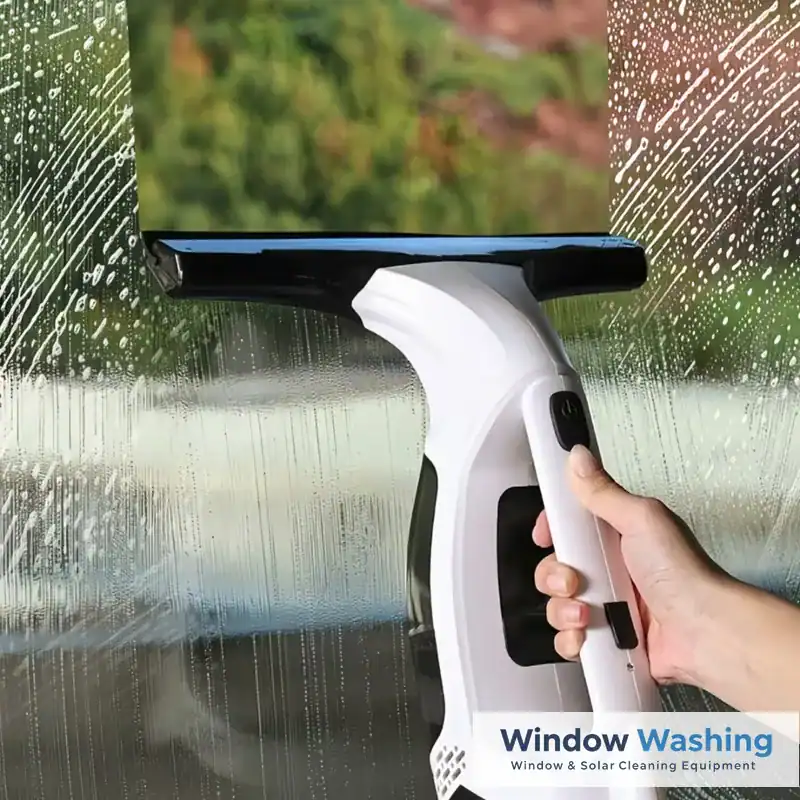
A window vacuum is a handheld tool that suctions water off glass instead of blading it away with a squeegee. It runs on a battery and collects the dirty water in a small onboard tank, which is why it leaves no drips on sills, floors or furniture. That single strength makes it a genuinely useful indoor tool. It does not, however, replace a squeegee or a water-fed pole once the work becomes daily, large-pane or above head height — and that is the decision most professional buyers are actually trying to make.
Where a window vacuum genuinely wins
Drip control is the real advantage. On interior glass a squeegee pushes water down onto the sill and the floor, so you follow it with a cloth. A window vacuum removes that second pass. Four situations suit it well.
- Interior glass in occupied homes and offices, where drips onto carpet or furniture are the problem, not speed.
- Small panes and glazing bars, where a 45cm blade cannot sit flat on the glass anyway.
- Shower screens, mirrors and splashbacks, which are enclosed and close-range.
- Conservatories and sunrooms with many small sections at arm’s reach.
Where it falls short for commercial volume
Four constraints decide it, and all four are structural rather than a question of which model you buy.
- Reach stops at your arm. A window vacuum cleans what you can touch. Anything above single-storey height needs a pole, a ladder or scaffolding, and ladders are what commercial method statements are usually written to avoid.
- The tank and battery interrupt the job. Both need emptying and recharging during a shift. A bucket and a squeegee do not stop.
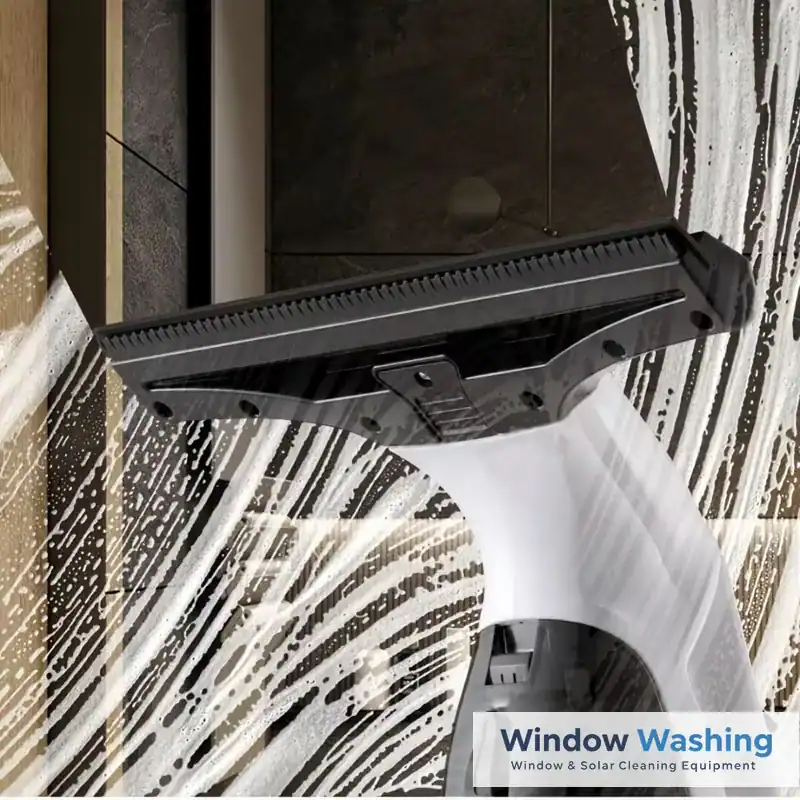
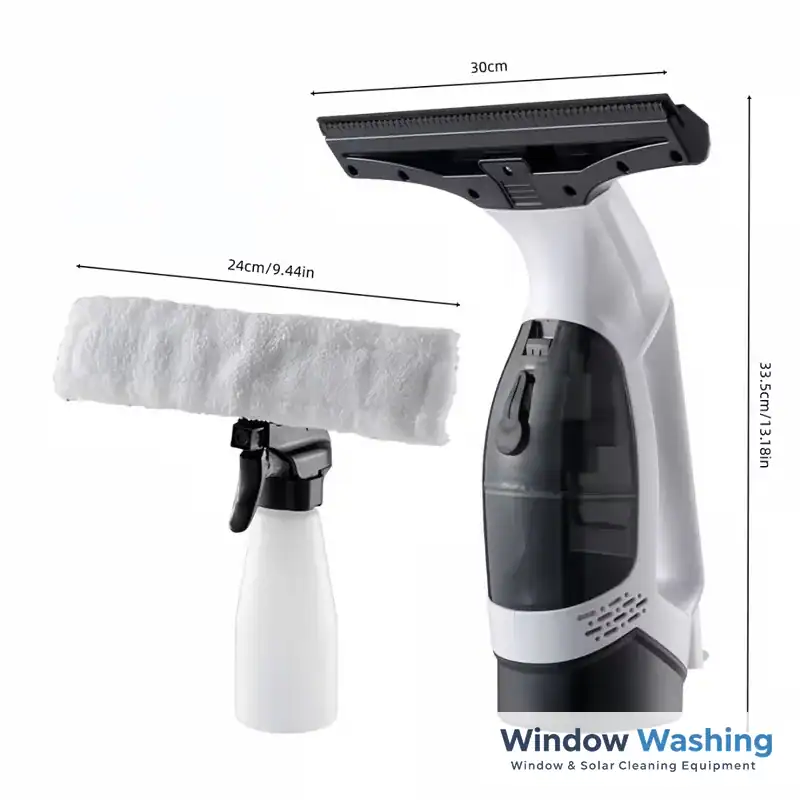
- It is slower on large glass. A 45cm squeegee clears a shopfront pane in one pass. A typical vacuum head is around 30cm, and it has to be lifted and emptied as the tank fills, so the same pane takes noticeably longer.
- It does not wash. A vacuum removes water. You still scrub first with a washer, so it is an extra tool in the kit rather than a replacement for one.
None of that makes a window vacuum a bad tool. It makes it an indoor detail tool rather than a volume tool.
What professionals use for volume and height
Two methods cover almost all commercial glass. Traditional squeegee work handles reachable panes fastest. Pure-water poles handle everything above head height from the ground.
- 45cm Window Squeegee — stainless-steel channel, replaceable Pulex rubber — R437.00, with a spare 71cm rubber at R97.75.
- 45cm Window Washer — the scrubbing half of the pair — R333.50.
- 9m Fibreglass Water-Fed Pole — three-storey reach from the ground, non-conductive near power lines — R8,970.00.
- 6m Water-Fed Pole Kit — complete pure-water system for two-storey work — R14,570.50.
Pure water is the part that does the work a vacuum cannot. Deionised water dries without spotting, so glass above head height needs no wiping and no second pass. Full ranges sit under Window Squeegees & Washers and Water-Fed Pole Equipment.
Side by side
| Window vacuum | Squeegee & washer | Water-fed pole | |
|---|---|---|---|
| Best for | Interior detail | Reachable glass, volume | Height, exterior |
| Typical reach | Arm’s length | Arm plus a short pole | 6–9 m from the ground |
| Speed on large panes | Slow | Fastest | Fast |
| Drips indoors | None | Needs a cloth | Not used indoors |
| Runs out mid-job | Battery and tank | No | No |
| Ladders needed above head height | Yes | Yes | No |
Choosing for a commercial contract
Match the tool to the dominant surface on the contract rather than buying one of everything. Three rules cover most decisions.
- Mostly interior glass in occupied space — a window vacuum earns its place alongside a washer, because it removes the drying pass.
- Mostly shopfronts and large reachable panes — a 45cm squeegee and washer will out-work a vacuum several times over.
- Anything above head height — a water-fed pole, because it removes ladders from the job entirely and leaves the glass spot-free.
Window Vacuum FAQs
Is a window vacuum good enough for commercial window cleaning?
A window vacuum suits interior and small-pane commercial work, where drips onto floors and furniture are the real constraint. It does not suit high-volume exterior glass, because reach stops at your arm and the battery and tank both interrupt the shift. Most commercial teams carry one for indoor detail and rely on a squeegee or a water-fed pole for everything else.
Can a window vacuum replace a squeegee?
No. A window vacuum removes water but does not wash the glass, so a washer is still needed to scrub first. On large panes a 45cm squeegee also clears in one pass what a narrow vacuum head needs many passes to cover. The two are complementary tools, and the squeegee remains the faster of the pair on volume work.
What do professionals use for windows above the ground floor?
A water-fed pole. Deionised or reverse-osmosis water is fed through a brush head on a telescopic pole, so glass up to roughly three storeys is cleaned and rinsed from the ground with no ladders. The 9m fibreglass pole at R8,970.00 is lighter than aluminium at that length and does not conduct electricity near overhead lines.
Does a window vacuum leave streaks?
Streaking comes from the water rather than the tool. Tap water carries dissolved minerals that dry as spots, whichever method lifts the water off. Purified water at close to zero ppm dries clear on its own, which is why pure-water systems are the standard for exterior glass. A TDS meter at R287.50 confirms the water is pure enough.
Building out a commercial kit rather than choosing a single tool? The full range of Professional & Commercial Window Cleaning Equipment covers squeegees, pure-water systems and reach equipment with trade pricing on request.