
How Often Should Solar Panels Be Cleaned?
Intervals by region and season — and how to read the answer off your own inverter instead of guessing.
The honest answer is that it depends on where you are, and the range in South Africa is wide — from twice a year on a coastal property that gets regular rain, to monthly on a farm near a gravel road in the dry season.
Most international guidance is written for wet northern climates and says once or twice a year. That advice travels badly to a country where large parts of the interior go three months without meaningful rain.
A starting schedule
| Your situation | Clean roughly |
|---|---|
| Coastal, regular rainfall, no dust sources nearby | Every 6 months |
| Suburban inland (Gauteng, Free State, inland KZN) | Every 3–4 months |
| Dry season, Highveld or Karoo, no rain for weeks | Every 2–3 months |
| Near a gravel road, farm, quarry or construction | Monthly to every 2 months |
| Coastal with salt exposure | Every 2–3 months |
| Heavy bird traffic or overhanging trees | As needed — bird mess is urgent |
Treat these as a starting point, then let your own data correct them.
Let the inverter decide
You don’t have to guess. Your inverter already measures the thing you care about.
The method: note your peak output on a clear day, then note it again on the next comparable clear day after decent rain. The difference between those two figures is what dirt is costing you.
- If rain recovers a useful chunk of output, that’s your cleaning interval — you’re losing that much between washes.
- If rain barely changes anything, your array isn’t soiling much and you can stretch the interval.
South African owners commonly report recovering somewhere in the region of 60 to 200 watts on a domestic array after a proper clean. Whether that justifies the effort depends on your system size and what you’re paying for grid power — but it’s a real number you can measure rather than argue about.
What makes panels soil faster
- No rain. The single biggest factor. Dust accumulates linearly with dry days.
- Low pitch. A near-flat array holds dust and water where a steep one sheds it. Flat-mounted panels need cleaning noticeably more often.
- Dust sources. Gravel roads, agriculture, mining, construction, unpaved yards.
- Salt air. Coastal film is sticky and holds dust that would otherwise blow off.
- Trees. Pollen, sap and leaf litter, plus the birds the tree brings.
- Bird mess. Different from dust — it’s opaque, it bonds hard, and a single dropping covering part of a cell can pull down a whole string through the bypass diode. This is the one case where you clean immediately rather than on schedule.
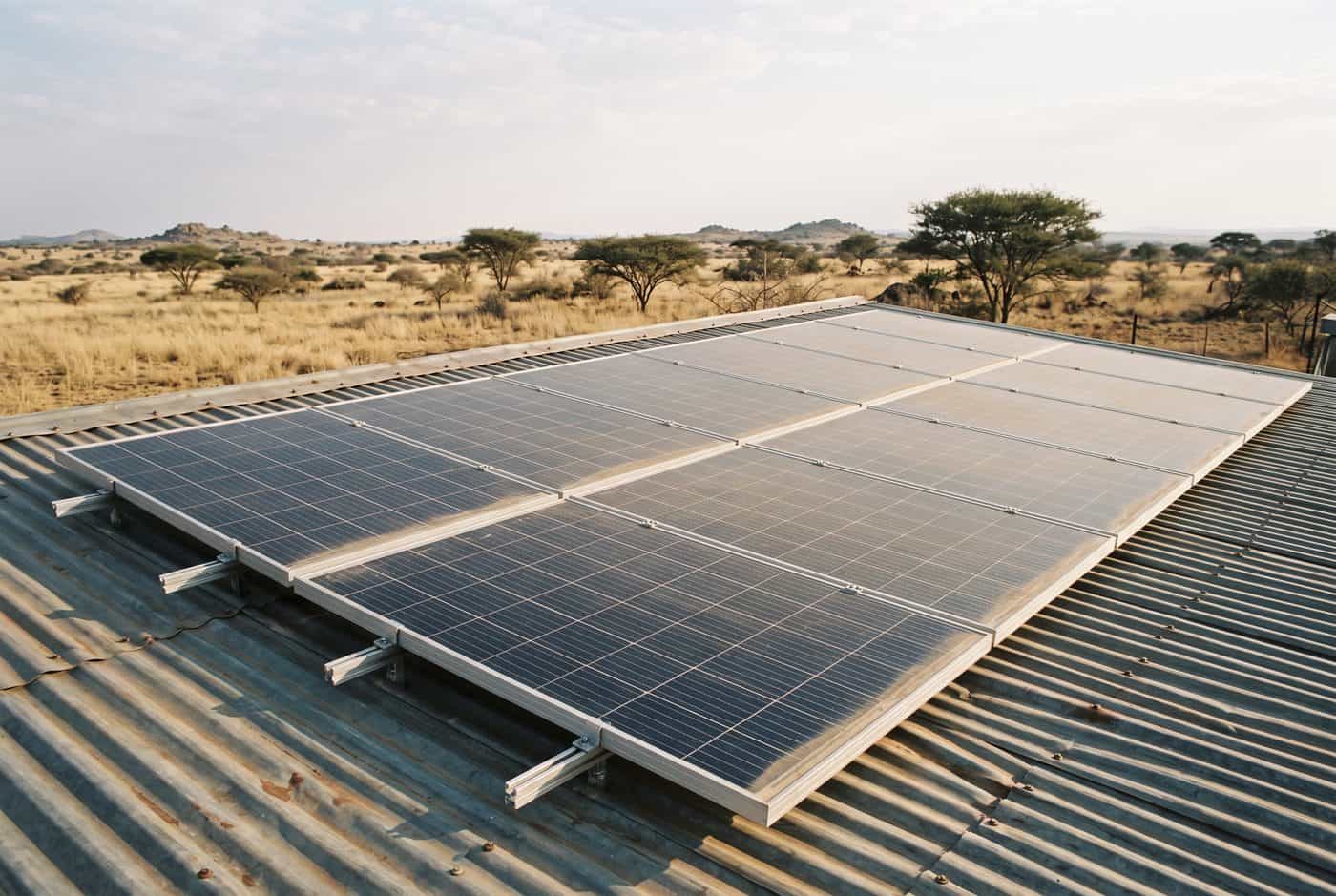
Why rain isn’t a substitute for cleaning
The most common objection is that rain washes the panels anyway. It partly does — and it’s why arrays in genuinely wet climates need less attention. But rain has three limits:
- It leaves a rim. Water runs down the panel and stops at the frame, depositing everything it carried at the bottom edge. That band of dirt sits directly over the lowest row of cells.
- It doesn’t shift bonded dirt. Bird mess, tree sap and baked-on dust don’t rinse off.
- Light rain makes things worse. A shower that wets dust and then dries in the sun leaves a set film — and if the rain has picked up dust on the way down, it dries as spotting.
Don’t clean too often either
There’s a real cost to over-cleaning, and it isn’t just your time.
Every clean is a chance to scratch the anti-reflective coating, and if you’re using hard tap water, every clean deposits a fresh layer of mineral spotting. People who wash their panels weekly with a hose and household detergent generally do more harm than the dust would have.
If you’re cleaning correctly — soft brush, purified water, cool panels — the risk is low. If you’re not, less often is genuinely better. The method matters more than the frequency: see how to clean solar panels.
Seasonal rhythm for South Africa
- Late winter / early spring (Aug–Sep). The most valuable clean of the year inland. Panels have been through months of dry, dusty weather with no rain, and you’re heading into the high-generation months.
- Summer (Nov–Feb), summer-rainfall regions. Regular thunderstorms do some of the work. Stretch the interval, but check after dust storms and hail.
- Autumn (Apr–May). Clear leaf litter and anything nesting under the array before winter.
- Winter, Western Cape. Winter rainfall keeps arrays cleaner; the dry summer is when Cape arrays need attention — the opposite of the inland pattern.
If you’re cleaning arrays for other people
Frequency is a service-plan question, not a technical one. The common structure in South Africa is a scheduled clean every three or four months on a standing arrangement, priced per panel — around R50 per panel is the typical market rate, adjusted for access.
The argument that sells the plan is the one above: the customer’s own inverter data. Record output before and after your first clean and the recurring booking makes itself.
On the equipment side, servicing arrays on a schedule means purified water and reach — a water-fed pole setup for residential work, and for larger arrays a rotating brush machine that covers ground fast enough for the per-panel rate to work. The costs are broken down in solar panel cleaning cost in South Africa.
Frequently asked questions
How often should solar panels be cleaned in South Africa?
Every three to six months for most homes, more often inland during the dry season or near dust sources, and less often on the coast in a wet winter. Use your inverter output to fine-tune it.
Is it worth paying someone to clean solar panels?
Sometimes — it depends on your losses and your access. Measure the recovery after one clean and compare it against the cost. For a roof-mounted double-storey array, paying someone is usually cheaper than buying a 9m pole and a water purification setup for one roof.
Can I clean them too often?
Yes. Mostly because of the method rather than the frequency. Frequent cleaning with hard water and detergent does more damage than dust. With a soft brush and purified water there’s little downside beyond your time.
When is the best time of day?
Early morning. The panels are cool, overnight dew has softened the dust, and you’re not interrupting peak generation.
Should I clean after a dust storm or hail?
After a dust storm, yes. After hail, inspect first — check for cracked glass before you put a brush anywhere near the array, and report damage to your insurer promptly.