
How to Clean Solar Panels
The method that actually works in South African conditions — and the four things that damage a panel.
Dirty panels cost you output. Dust, pollen, bird mess and the fine grey film that settles over a Highveld winter all block light before it reaches the cell. In South Africa’s dry months, on an array that hasn’t seen rain in weeks, that’s a measurable loss — and owners on local forums routinely report recovering 60 to 200 watts after a proper clean.
The method matters as much as the frequency. Done wrong, cleaning leaves the panels worse than before: hard-water spots baked onto the glass, a detergent film that attracts dust faster than it shed it, or in the worst case a cracked panel and a void warranty.
Here is how it’s actually done.
The short answer
- Clean early morning or on an overcast day, while the panels are cool.
- Use a soft brush on a pole, from the ground where possible.
- Use purified water — no detergent, no chemicals.
- Rinse and walk away. Don’t dry the panels.
- Never walk on the array, and never pressure wash it.
Everything below is the reasoning behind those five points.
Clean when the panels are cool
A panel in full sun can sit well above 60°C. Hitting that glass with cold water risks thermal shock, and in the worst case a microcrack you won’t see until output drops. Water also evaporates almost instantly on hot glass, which means any dissolved minerals in it dry onto the surface before you can rinse them off.
Early morning is the best window. The panels are cool, dew has already softened the dust overnight, and you’re not competing with peak generation. Overcast days work equally well.
Why water quality is the whole game
This is the part almost everybody gets wrong, and it’s why so many people conclude that cleaning “didn’t help”.
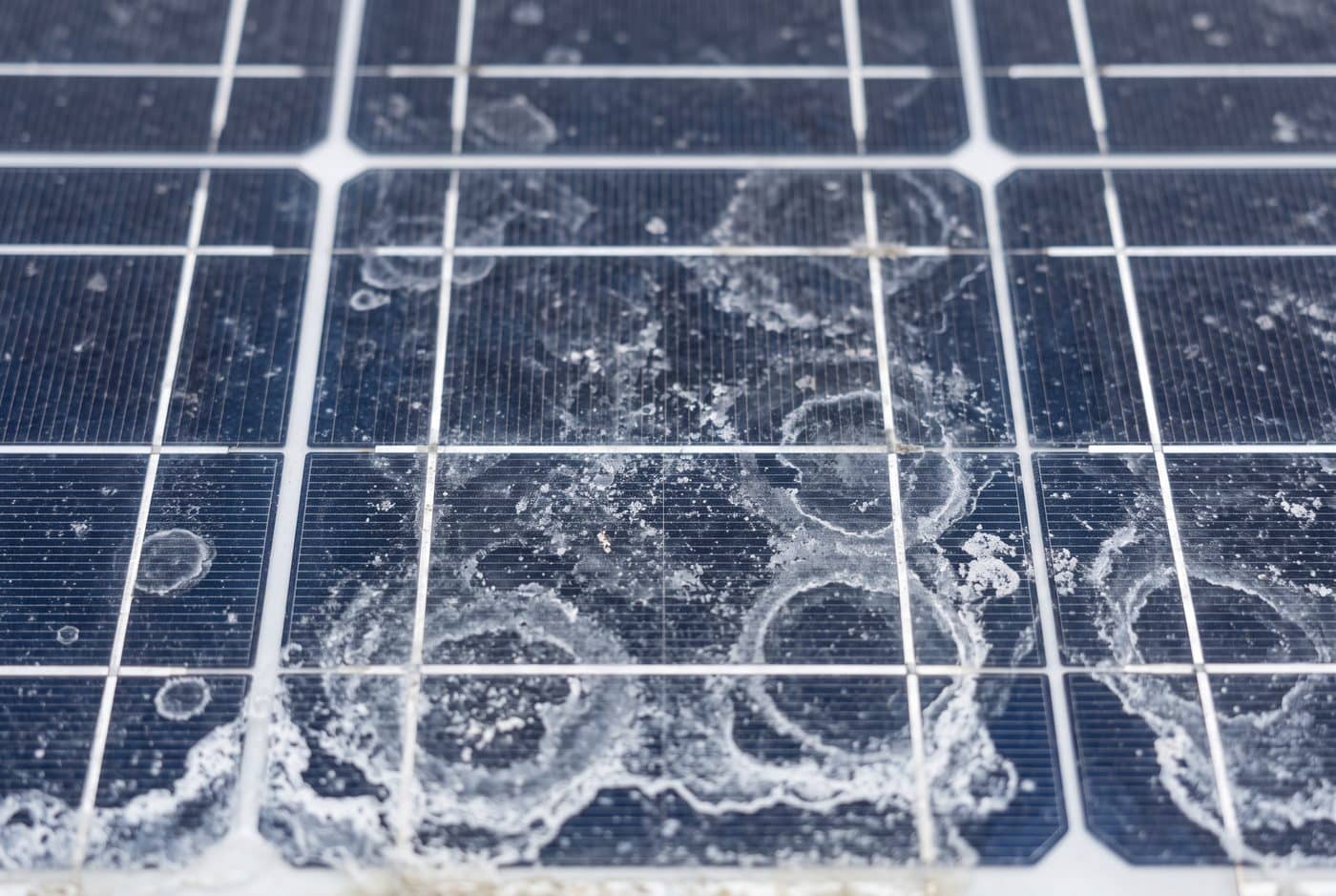
Municipal tap water carries dissolved minerals — calcium, magnesium, salts — measured as TDS in parts per million. Hose a panel down with it and the water evaporates while the minerals stay behind as white spots. On a panel, that mineral film scatters light, so you can genuinely finish a clean with worse output than you started with.
The complaint turns up constantly among solar owners:
“I used a hose with standard tap water and it left noticeable water stains all over the glass.”
Purified water has the dissolved solids stripped out, so there’s nothing left to deposit. It evaporates clean off the glass and the panel dries itself — no drying cloth, no streaks, no spots. It’s also a more aggressive solvent than tap water, so it lifts grime as it runs.
This is why installers and manufacturers generally specify deionised water. If you’re cleaning more than your own roof, a TDS meter and a way of purifying water are not optional extras — they’re the difference between a professional finish and a spotted one. Our pure water setup guide walks through what that costs and how to size it.
If you only have tap water
Clean in the early morning, keep the surface wet throughout so nothing dries mid-job, rinse thoroughly at the end, and if your water is hard, dry the glass with a clean microfibre rather than letting it air dry. It’s a compromise, not the correct method — but it beats leaving the panels dirty.
What not to use
- No detergent, dish soap or vinegar. These are the most common home remedies and all three are a mistake. Detergent leaves a residue film that attracts dust, so the panels re-soil faster. Over time soaps and acids can degrade the panel’s edge seal and its anti-reflective coating.
- No pressure washer. High pressure can drive water past the frame seals into the junction box and can damage the anti-reflective coating. Most manufacturers explicitly warn against it — we cover this in detail in can you pressure wash solar panels?
- No abrasive pads, scourers or hard-bristle brushes. The anti-reflective coating scratches, and scratches are permanent.
- No metal scrapers or blades. Fine on window glass, never on a panel.
Don’t walk on the panels
Standing on an array is the fastest way to turn a cleaning job into an insurance claim. Panel glass is designed for evenly distributed load — hail, snow, wind — not for a person’s weight on one point. The damage is usually microcracking in the cells, which is invisible from the surface and shows up later as a dead string and a lower yield.
It will also, in most cases, void the panel warranty.
Clean from the ground with a pole wherever it is physically possible. Where it isn’t, work from the roof edge or a stable platform and reach in — never step onto the array itself. We cover roof-mounted arrays specifically in cleaning solar panels on a roof.
The equipment
What you need depends on whether this is your own roof once or twice a year, or work you’re doing for money.
For your own array
A soft-bristle brush on a telescopic pole and the cleanest water you can get. If your array is single-storey and accessible, a telescopic pole plus a soft brush head will do the job. Add a TDS meter if you want to know whether your tap water is going to spot.
For cleaning as a service
You need purified water and reach, and you need to work fast enough for the job to pay. That means a water-fed pole fed from a purification setup — see our water-fed pole equipment — or, for larger arrays, a dedicated rotating brush machine.

A 7.5m rotating solar brush kit covers an array several times faster than a hand brush, which is what makes commercial and farm-scale work viable. The full range is on our solar panel cleaning equipment page.
Step by step
- Check the weather and the time. Early morning, panels cool to the touch. Not in full midday sun.
- Look before you clean. Note any cracked glass, discoloured cells, lifted seals or loose mounting. Cleaning won’t fix those and you want to know before you start, not after.
- Clear loose debris. Leaves, twigs and bird nests — including underneath the panels, where they trap heat and moisture.
- Wet the surface. Let the water sit briefly to soften bonded dirt. Don’t attack dry dust with a brush; you’ll drag grit across the coating.
- Brush gently, top to bottom. Soft bristles, light pressure. The water does the work, not the scrubbing.
- Rinse with pure water and stop. If your water is purified, walk away — the panel dries itself. Wiping only adds streaks and risks scratching.
- Check the inverter. Note output before and after. It’s the only honest measure of whether the clean was worth doing.
Does cleaning actually make a difference?
It depends where you are, and this is worth being straight about. In wet climates with regular rainfall, studies and owner reports often show gains of only a couple of percent — not enough to justify paying someone.
South Africa is a different case. Much of the country is dry and dusty for months at a stretch, and rain does not clean a panel properly — it runs off, leaves a dust rim along the bottom edge of the frame, and if it’s followed by dry wind the film sets. Local owners consistently report meaningful recovery after cleaning, and arrays near farms, mines, gravel roads or the coast soil far faster than the international averages assume.
The way to settle it for your own array is your inverter data. Record output on a clear day before cleaning and on a comparable day after. If you’re not gaining anything, clean less often. If you’re recovering a useful chunk, you have your answer.
Frequently asked questions
Can I clean solar panels with a hose?
Partly. You can rinse loose dust off with a hose, and on a cool morning that’s better than nothing. But hard tap water will leave mineral spots as it dries, and a hose alone won’t shift bonded grime or bird mess. It’s a holding measure, not a clean.
What is the best thing to clean solar panels with?
Purified (deionised or RO) water and a soft brush. Nothing else. The whole point of pure water is that it needs no additives and leaves no residue.
Will cleaning void my warranty?
No, not if you clean correctly. Many manufacturers require regular cleaning and inspection as a condition of warranty. What voids it is walking on the array, pressure washing, abrasives and harsh chemicals.
Should I dry the panels afterwards?
No. If you’ve used purified water it dries spot-free on its own and wiping risks scratching. If you’ve used hard tap water, drying with a clean microfibre is the lesser of two evils.
How much does it cost to have panels cleaned in South Africa?
Around R50 per panel is the common market rate, varying with access and array size. We break the economics down in solar panel cleaning cost in South Africa.