
Pure Water Setup
Sizing a reverse osmosis system, what it really costs to run, where you store the water and how you get it to site.
Pure water is the whole trick behind water-fed pole cleaning. Get the water right and glass and solar panels dry on their own, spot-free, with no ladders, no squeegee and no drying cloth. Get it wrong and you leave white spots on every pane you touch.
This guide covers the part most buyers only work out after they’ve spent the money: how much pure water you actually need, what it costs to make, how to size a reverse osmosis system, and how you get the water from your tap to a panel four metres in the air.
What a water-fed pole actually is
A water-fed pole is a telescopic pole with a soft brush head on the end and water jets built into that head. A hose runs up the inside of the pole. You stand on the ground, scrub the glass with the brush while purified water flows through the jets, then rinse and walk away. There is no squeegee stage and nothing gets dried.
Two things make it work:
- Reach from the ground. A 6m pole reaches a double-storey window or a roof-mounted solar array. A 9m pole reaches third-storey. Nobody goes up a ladder and nobody walks on a roof.
- Water that leaves nothing behind. This is the part that matters, and it’s where most people come unstuck.
Why ordinary tap water ruins the job
Municipal water carries dissolved minerals — calcium, magnesium, salts. That load is measured as TDS (total dissolved solids) in parts per million, and you read it with a TDS meter.

When tap water dries on glass, the water evaporates and the minerals stay put. That’s the white spotting people see after hosing down their windows or solar panels. It is not dirt and wiping usually makes it worse.
Purified water behaves the opposite way. With the dissolved solids stripped out there is nothing left to deposit, so the water simply evaporates and the surface dries clear. Pure water is also an aggressive solvent — it actively lifts dissolved grime off the surface as it runs, which is why the method cleans as well as it rinses.
The working target is under about 10 ppm at the brush head. Above that you start seeing spots. Around zero, you can rinse and walk away in confidence.
RO and DI: what each one does
There are two ways to strip dissolved solids out of water, and the important thing is that they are not alternatives — they do different jobs.
Deionisation (DI)
A DI tank is filled with mixed-bed resin. Water passes through and the resin swaps the dissolved minerals for pure water ions. Output is essentially 0 ppm immediately — plug it in, connect a hose, start work.

The catch: resin has a fixed exchange capacity. Every milligram of dissolved solids it removes uses some of that capacity up permanently. When it’s spent, you buy more.
Reverse osmosis (RO)
A reverse osmosis system pushes water through a semi-permeable membrane under pressure. The membrane rejects most dissolved solids — typically 90–97% — and sends them to drain.
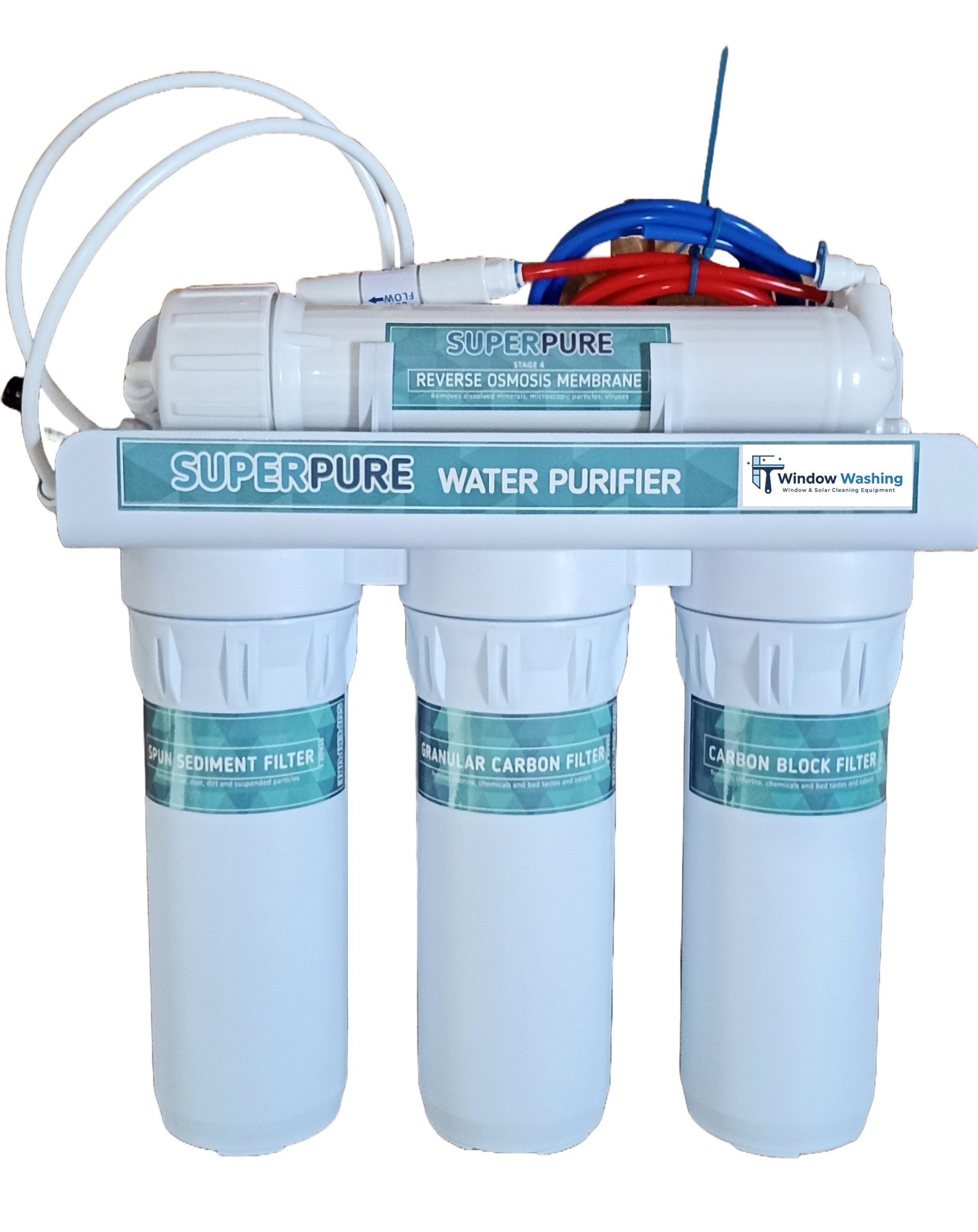
RO does not usually reach 0 ppm on its own, so it can’t replace DI. What it does is remove the bulk of the load cheaply, before the resin ever sees it. The membrane is not consumed the way resin is; with clean prefilters it lasts years.
Why DI on its own gets expensive
This is the single most useful piece of arithmetic in the whole business, and it’s the reason experienced operators run RO.
Resin capacity is consumed in proportion to how much dissolved solid it has to remove. Double the incoming TDS and you halve the litres of pure water you get per charge. As a working approximation, one litre of mixed-bed resin produces roughly 1,000 litres of pure water from a 100 ppm feed.
Resin is R250 a litre excluding VAT. All running-cost figures below are ex-VAT, since this is a trade calculation — the cart price includes VAT at 15%. That scales like this:
| Your tap water TDS | Litres of pure water per 1 L resin | Resin cost per 1,000 L of pure water |
|---|---|---|
| 50 ppm (soft) | ~2,000 L | ~R125 |
| 100 ppm | ~1,000 L | ~R250 |
| 200 ppm | ~500 L | ~R500 |
| 300 ppm (hard) | ~333 L | ~R750 |
| 500 ppm (very hard) | ~200 L | ~R1,250 |
Now put an RO in front of it. If your feed is 300 ppm and the membrane rejects 95%, the resin now sees about 15 ppm instead of 300 ppm — so it lasts roughly twenty times longer:
| Tap TDS | After RO | Litres per 1 L resin | Resin cost per 1,000 L |
|---|---|---|---|
| 100 ppm | ~5 ppm | ~20,000 L | ~R13 |
| 200 ppm | ~10 ppm | ~10,000 L | ~R25 |
| 300 ppm | ~15 ppm | ~6,700 L | ~R37 |
| 500 ppm | ~25 ppm | ~4,000 L | ~R63 |
At 300 ppm feed water, the same 1,000 litres of pure water costs about R750 in resin on DI-only, or about R37 with an RO in front.
So does RO always pay?
No — and this is where a lot of advice is misleading. It depends entirely on your volume.
- Working most days. Say 300 L a day, 20 days a month — 6,000 L. On DI-only at 300 ppm that’s roughly R4,500 a month in resin. With RO it’s roughly R220 plus prefilters. A R4,370 RO system pays for itself in about five weeks.
- Occasional use. A few jobs a month, maybe 200 L total, and your resin bill is about R150 a month. An RO would take well over two years to pay back. Start DI-only and add RO when your volume justifies it.
Test your tap water before you decide anything. A TDS meter answers the question in ten seconds and it’s the cheapest thing you’ll buy. Cape Town’s supply is generally soft; much of Gauteng and the inland towns run considerably harder, and borehole water can be several hundred ppm.
For a deeper comparison of the two setups, see RO vs DI: which pure-water setup should you buy?
Sizing an RO system: output per 24 hours
RO systems are rated in litres per day. Our 1,030 L/day system produces about 43 litres an hour under its rated conditions.
Two things to understand about that number:
1. The rating assumes warm water and decent pressure
Membrane output is rated around 25°C with adequate feed pressure. Cold water is more viscous and passes through more slowly. In a Highveld or Cape winter, expect roughly 60–75% of the rated figure. Low municipal pressure reduces it further. Size with that in mind rather than the sticker number.
2. You do not size the RO to keep up with your pole
This is the mistake that makes people overspend. A water-fed pole uses roughly 1.5 litres a minute at the jets — about 90 litres an hour of continuous flow. No small RO can match that in real time, and it doesn’t need to.
What matters is whether the RO can refill your storage between shifts. Work the sum the other way round:
- Your water is only running while the brush is on the glass — typically 2–4 hours in a working day, not eight.
- Three hours of actual flow is roughly 270 litres a day for a one-man operation.
- A 1,030 L/day unit left running for 16 hours overnight makes around 690 litres — and in winter still around 450.
So one small RO comfortably supports a one- or two-man operation, provided you have somewhere to put the water.
Small RO versus a trolley
| 1,030 L/day RO — R4,370 | RO trolley — R17,054 | |
|---|---|---|
| Where it lives | Fixed at your base | Mobile — goes to site |
| How you work | Batch-fill overnight, carry water to the job | Connect to any tap on site and produce as you go |
| Storage needed | Yes — a flowbin or tank | Little or none |
| Best for | Working from a yard or home base within reach of your jobs | Travelling work, multi-day sites, jobs where carrying water is impractical |
The decision is about logistics, not water quality — both produce the same result. If you can batch-fill at base, the small unit plus storage is far cheaper per litre. If you’re working across a province or on sites where you can’t get a bakkie close, the trolley earns its price in time saved.
Don’t forget the reject water
RO sends the rejected minerals to drain. On a small unit at municipal pressure you should expect roughly three to four litres to drain for every litre produced. That reject is only slightly concentrated tap water — perfectly good for irrigation, washing the vehicle or topping a pool. In a country with water restrictions, plumb it into a second container rather than letting it run down a stormwater drain.
Storing pure water: the flowbin
A slow RO plus a big tank beats a fast RO with nowhere to put the output. Storage is what turns 43 litres an hour into a working day’s water.
A 1,000 litre flowbin is the standard answer — cheap, stackable, and roughly three to four days of water for a one-man operation. An IBC tank does the same job.
Three rules for storing pure water:
- Food-grade HDPE, never metal. Pure water is aggressive and will pick ions straight out of a metal tank, undoing the work you just paid for.
- Keep it sealed and opaque. Light grows algae. An open tank also lets in dust and absorbs carbon dioxide from the air, which slowly nudges your TDS back up.
- Dedicate it. A container that has held anything else will contaminate the batch. Pure water picks up whatever it touches.
Position the bin high enough to gravity-feed your containers, or draw from it with your pump.
Getting water to site: 25 litre containers
From the flowbin you decant into sealed 25 litre containers. Twenty-five litres is twenty-five kilograms — about the practical limit for carrying one-handed across a garden or up a flight of stairs.
Some useful figures:
- At 1.5 L/min, one 25 L container is about 17 minutes of continuous poling.
- A typical residential solar array of 12–20 panels uses roughly 50–100 litres — two to four containers.
- A domestic double-storey window clean runs similar.
Keep the containers dedicated to pure water and keep the caps on. A can that had tap water in it last week will lift your TDS the moment you fill it.
Where the pump comes in
A water-fed pole needs pressure behind it. Gravity from a tank on the back of a bakkie will not push water nine metres up a pole with any useful flow. Something has to pressurise it.

The mobile answer is the 15 litre electric water-fed pole pump — a self-contained unit that carries its own water and pressurises it, battery powered, that you take to the work rather than running hose to.
It earns its place in exactly the situations where a vehicle-mounted setup fails:
- Complexes and security estates where you cannot park near the units
- Rooftop plant rooms and internal courtyards
- Multi-building sites where you’d otherwise be dragging fifty metres of hose between blocks
- Any job where the client would rather not have hose across their driveway
At 15 litres it holds about ten minutes of continuous flow, so it works as a carry-to-the-work unit that you top up from your 25 litre containers as you go — not as your only water supply.
The complete chain
Put end to end, a working pure-water setup looks like this:
Tap → RO (bulk removal, cheap) → DI (polish to zero) → flowbin (store at base) → 25 L containers (transport) → 15 L pump (pressurise on site) → water-fed pole (scrub and rinse) → clean glass or panels that dry themselves.
You can start anywhere on that chain and build backwards. Most operators begin with a DI tank, a pole and a pump, discover what their resin bill looks like, and add the RO and storage once the volume justifies it. That is a perfectly sensible order to buy in — as long as you test your tap water first, so you know which chapter of the story you’re in.
South African Considerations: Hard Water, Load-Shedding & Spares
Hard Water in Gauteng and the Free State
TDS levels in Johannesburg, Pretoria, and Bloemfontein often exceed 200 ppm. RO filtration is mandatory here. A DI-only system would exhaust resin within days and cost far more to operate. Budget for RO membrane replacement every 2–3 years (around R600–R800) and pre-filter changes every 3–6 months (R150–R300 for a set).
Load-Shedding Workarounds
Stationary RO systems need mains power. If you’re producing water overnight and storing it in tanks, this isn’t an issue. For daytime production during load-shedding, you need either an inverter setup or the battery-powered mobile pump paired with pre-filled containers of RO water. The trolley system that runs on municipal pressure (no electricity) is another option.
Spares Availability
Pole sections, brush heads, and hose connections are standardized. Replacement brushes and hose are readily available. RO membranes and pre-filters are stocked locally; delivery takes 3–5 days nationwide. Keep one spare set of pre-filters on hand to avoid downtime.
Maintenance Schedule
Weekly: Rinse pole sections and brush head. Check hose connections for leaks.
Monthly: Test output TDS. If above 10 ppm, check RO membrane and DI resin levels. Clean pre-filters if water pressure drops.
Every 3–6 months: Replace pre-filters. Inspect pump battery condition.
Every 2–3 years: Replace RO membrane. Refresh DI resin fully.
A TDS meter (around R150–R300 online) is essential. Test your source water and output water weekly. Output should stay at 0–5 ppm for perfect results.
When Does a WFP System Pay for Itself?
If you’re charging R1,500–R2,500 per double-storey home or R2,000–R4,000 for solar panel cleaning on a large residential array, the system pays for itself in 5–10 jobs. Speed and safety are the real benefits: you can clean a double-storey home in 45 minutes from the ground instead of 90+ minutes with ladders.
For solar panel contracts, WFP is the only practical method. Panels need gentle scrubbing and spot-free rinsing without walking on roofs. A commercial solar cleaning business doing 3–4 properties per week will recover the investment within the first month.
Frequently asked questions
What TDS do I need for spot-free results?
Under about 10 ppm at the brush head. Zero is ideal. Check it with a TDS meter at the pole, not at the tank — a long hose run and a tired resin bed can both push the reading up.
Can I just use rainwater?
Sometimes. Rainwater is naturally low in dissolved solids, which is why rain itself doesn’t spot glass. But by the time it has come off a roof and through a gutter it has picked up dust, organics and whatever the roof sheeting is made of. Test it — some collected rainwater is genuinely usable as RO feed and will save your membrane a lot of work.
How long does a DI resin charge last?
Entirely dependent on your feed TDS. From soft 50 ppm water, one litre of resin will make around 2,000 litres. From hard 300 ppm water, closer to 330 litres. That variation is the whole argument for RO.
Does the water have to be hot?
No. Pure water cleans cold. Heat is unnecessary and on solar panels it’s actively unwanted.
Can I use pure water on solar panels?
Yes — it is the recommended method. Panel manufacturers generally advise against detergents, which can degrade edge seals and leave a residue that attracts dust. See our solar panel cleaning equipment for the brushes and machines built for it.