
Solar Panel Maintenance
What actually needs doing beyond cleaning, how often, and what you can check yourself from the ground.
Solar arrays are often sold as fit-and-forget, and mostly they behave that way — there are no moving parts and nothing needs servicing in the way an engine does. But “no moving parts” is not the same as “no maintenance”. Panels soil, seals age, rodents chew cabling, and inverters fail quietly.
The cost of ignoring it is rarely dramatic. It’s a slow drift downward in yield that nobody notices because there’s nothing to notice — the system still works, it just works less well every year.
Here’s what actually needs doing, and how often.
The maintenance that matters
| Task | How often | Who |
|---|---|---|
| Check inverter output against expectation | Monthly | You |
| Visual check of array from the ground | Quarterly | You |
| Clean the panels | Every 3–6 months, environment-dependent | You or a contractor |
| Clear debris from under and around panels | With each clean | You or a contractor |
| Inspect mounting, seals and cable runs | Annually | Contractor |
| Electrical inspection, connections, isolators | Annually or per warranty | Qualified electrician |
| Battery health check (if fitted) | Annually | Installer |
Monitoring is the cheapest maintenance there is
Your inverter already tells you almost everything you need to know, and most owners never look at it beyond the first month.
What to watch:
- Daily peak output on clear days. Compare like with like — the same season, similar weather. A gradual decline over a dry stretch is soiling. A sudden step down is a fault.
- One string underperforming another. If your inverter reports per-string or per-panel data, an outlier usually means shading, a failed bypass diode, or a cracked panel.
- Output that recovers after rain. That’s your array telling you it needs cleaning, and roughly how much you’re losing to dirt.
That last one is the useful trick: if a decent rain shower bumps your output back up, the gap between the dirty figure and the clean figure is what soiling is costing you. If rain makes no difference, you can clean less often and save the effort.
Cleaning: the part with the biggest yield effect
Of everything on the list, cleaning is the item that most directly moves output, and it’s the one most likely to be done badly.
The essentials:
- Purified water, no detergent. Tap water leaves mineral spots as it dries, which scatter light — you can genuinely end a clean with worse output. Detergent leaves a film that attracts dust and can degrade edge seals over time.
- Soft brush, light pressure. The anti-reflective coating scratches and doesn’t recover.
- Cool panels only. Early morning or overcast. Cold water on hot glass risks thermal shock.
- Never walk on the array, and never pressure wash it.
Full method in how to clean solar panels, and the access side in cleaning roof-mounted arrays.
What to look for on a visual check
You can do most of this from the ground with binoculars, quarterly, in about ten minutes.
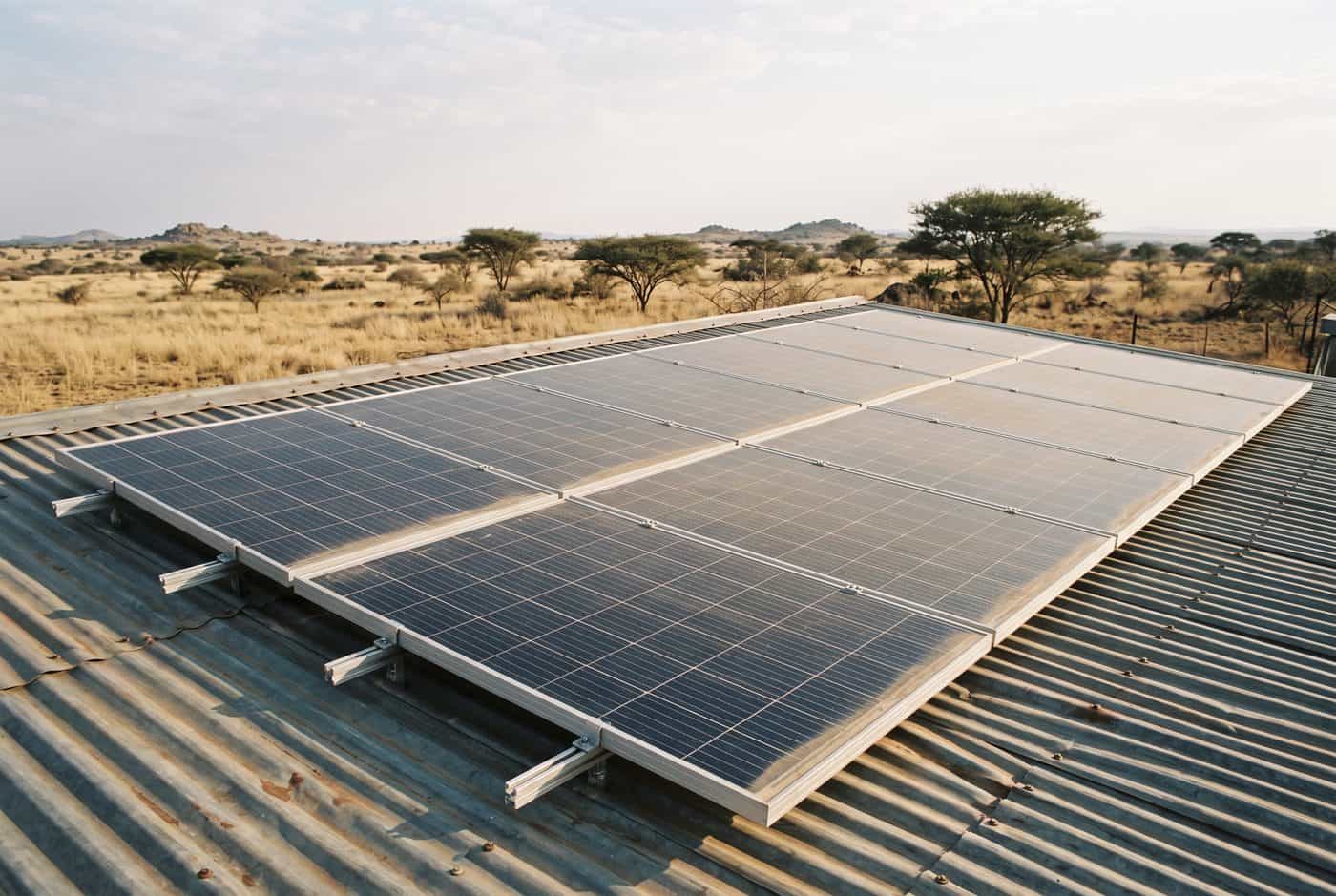
On the panels
- Discoloured or browning cells — usually encapsulant degradation. Not fixable, but worth logging against warranty.
- Snail trails — fine dark lines across cells, a sign of microcracking, often from earlier mishandling or someone having stood on the panel.
- Cracked or chipped glass — hail damage is common on the Highveld. Treat a cracked panel as an electrical hazard and isolate it.
- Delamination or bubbling — moisture ingress; the panel is failing.
- Lifted or perished edge seal — the route moisture takes to get in. Often the first sign of a panel nearing end of life.
Around the array
- Debris underneath — leaves and nesting material trap heat and hold moisture against the roof. Birds and rodents nest under arrays constantly in South Africa, and rodents chew DC cabling.
- New shading — a tree that’s grown, a neighbour’s addition, a new aerial. Partial shade on one panel can drag a whole string down.
- Loose or corroding mounting — check rails and clamps, particularly on coastal properties where salt accelerates everything.
- Cable sag or exposed cabling — DC cable resting on hot sheeting or drooping into a gutter will fail eventually. It should be clipped and shaded.
South African conditions worth planning for
- Dust. Inland regions go months without rain. Gauteng, the Free State, the Karoo and anywhere near gravel roads, farms or mining will soil far faster than international maintenance guidance assumes.
- Salt. Coastal arrays build a salt film that is sticky, holds dust, and accelerates corrosion on mounting hardware. Coastal properties need more frequent cleaning and closer attention to the rails.
- Hail. Highveld summer storms. After a significant hail event, check the array — cracked glass may not be obvious from the ground, and your insurer will want it reported promptly.
- Birds. Pigeons nest under panels wherever there’s a gap at the eaves. Mesh skirting around the array perimeter is cheap and solves it permanently.
- Load-shedding cycling. Hybrid and battery systems switch far more often here than they were designed around. That’s an inverter and battery consideration rather than a panel one, but it’s the component most likely to fail first.
What you can do yourself and what you shouldn’t
Do yourself: monitoring, ground-level visual checks, clearing debris, and cleaning — provided you can reach the array safely from the ground with a pole and you have decent water.
Get someone in for: anything requiring roof access on a pitch or at height, any electrical work, anything behind an isolator, and any inspection tied to a warranty condition. Panel warranties frequently require documented regular maintenance, and a contractor’s report is the documentation.
Equipment for maintaining your own array
For a single-storey home array within reach of a pole, the practical kit is a telescopic pole with a soft brush head, and a TDS meter to tell you whether your tap water will spot.
If it will — and in much of the country it will — you need a way to purify water. For occasional home use a DI tank is the simplest answer. If you’re maintaining several arrays or doing it commercially, an RO system in front of the DI cuts the running cost dramatically — the arithmetic is in our pure water setup guide.
For larger arrays and commercial work, the solar panel cleaning machines cover an array several times faster than a hand brush.
Frequently asked questions
Do solar panels need maintenance?
Yes, but not in the mechanical sense — there’s nothing to service. But they need cleaning, periodic visual inspection, and an annual electrical check. The panels themselves are the most reliable part of the system; inverters and batteries fail long before panels do.
How long do solar panels last?
Most carry a 25-year performance warranty and degrade slowly, typically well under 1% a year. Inverters generally need replacing at around 10–15 years, and batteries sooner than that.
Does maintenance affect my warranty?
Yes, frequently. Many manufacturers make regular cleaning and inspection a warranty condition, and equally will refuse a claim where damage came from pressure washing, harsh chemicals or someone walking on the array. Keep records.
What’s the most common problem?
Soiling, by a wide margin — and it’s the easiest to fix. After that: shading from vegetation that has grown since installation, and inverter faults.
How do I know if a panel has failed?
Per-string or per-panel monitoring is the reliable way. Without it, look for output that’s persistently below what comparable clear days used to produce, and check the array visually for discoloured cells or cracked glass.